


Modern floral design: principles, trends & applications
TL;DR:
- Modern floral design emphasizes clean lines, negative space, and deliberate restraint over busy, densely packed arrangements.
- It relies on principles like asymmetry, strong shapes, and architectural blooms such as orchids and calla lilies.
- Fewer, carefully chosen flowers in sculptural vessels create more impactful, elegant arrangements suitable for corporate, luxury, and sympathy occasions.
There is a widespread assumption that the most impressive floral arrangements are the busiest ones, packed with dozens of stems, swirling ribbons, and every colour imaginable. In reality, modern floral design does the opposite: it uses clean lines, strong shapes, open space, and deliberate restraint to create something far more striking. Whether you are planning a corporate event in Birmingham, choosing a luxury gift for someone in Solihull, or marking a significant occasion, understanding how contemporary floral principles work will help you make choices that genuinely impress. This guide walks you through everything you need to know.
Table of Contents
- What defines modern floral design
- How modern techniques create impact
- Modern versus traditional floral design: Key differences
- Expert nuances, current trends, and application in Birmingham and Solihull
- Our unique take: Why less truly is more in modern floral design
- Bring modern floral elegance to your next occasion
- Frequently asked questions
Key Takeaways
| Point | Details |
|---|---|
| Less is more | Modern arrangements rely on a few striking blooms and negative space for maximum impact. |
| Balance and dynamics | Asymmetry, contrast, and focused balance are the hallmarks of contemporary floral style. |
| Sustainability counts | Eco-friendly methods like foam-free mechanics are integral to the latest trends. |
| Local trends matter | Birmingham and Solihull events lead with bold forms, warm neutral palettes, and innovative designs. |
What defines modern floral design
Modern floral design is not simply a matter of using fewer flowers. It is a disciplined approach rooted in specific principles that guide every decision, from the choice of bloom to the angle of each stem.
At its core, modern design prioritises negative space, which is the deliberate use of empty areas within and around an arrangement. Rather than filling every gap, a skilled florist leaves breathing room so that each flower can be seen and appreciated on its own terms. This is what gives contemporary arrangements their calm, gallery-like quality.
The seven fundamental principles that underpin modern floral design are:
- Balance: Asymmetrical rather than symmetrical, creating a dynamic, living feel
- Scale and proportion: Each element chosen for its relationship to the whole
- Dominance: A single, clear focal point that draws the eye
- Rhythm: Visual flow that moves the eye through the arrangement
- Contrast: Differences in form, size, and colour that create energy
- Harmony: A sense that every element belongs together
- Negative space: Intentional emptiness that amplifies what is present
Alongside these principles, the key design elements include line (which creates movement), form (the overall outline), texture (which adds depth), and colour (used for emotional effect, often through quiet palettes or bold contrast).
When it comes to flower selection, modern arrangements favour architectural blooms with strong, sculptural forms. Orchids, calla lilies, and anthuriums are popular choices because their shapes hold visual weight without requiring volume. These are often placed in glass, metal, or ceramic vessels that complement the clean aesthetic rather than compete with it. You can see how these ideas come together in elegant flower arrangements designed for a range of occasions.
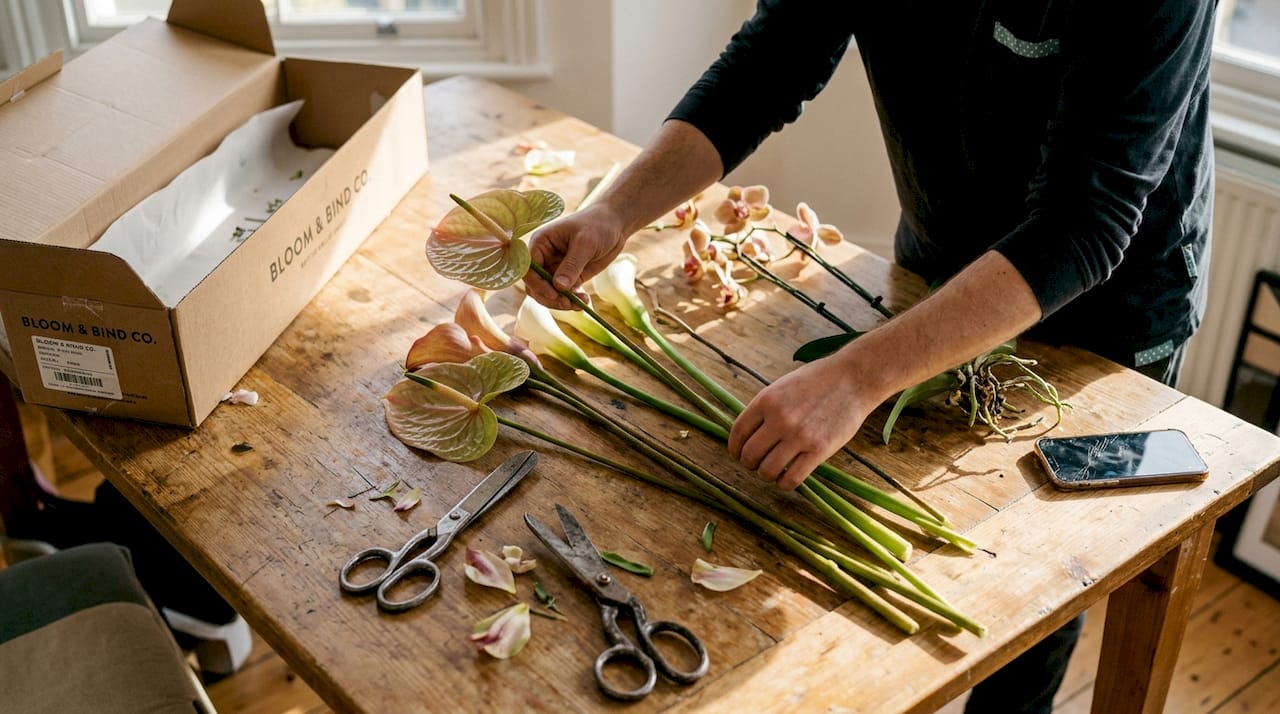
| Element | Traditional approach | Modern approach |
|---|---|---|
| Colour palette | Multi-colour, vibrant | Restrained, tonal, or mono |
| Flower choice | Roses, peonies, carnations | Orchids, calla lilies, anthuriums |
| Space use | Filled completely | Negative space intentional |
| Symmetry | Symmetrical, round | Asymmetrical, dynamic |
| Container | Ceramic vase, basket | Glass, metal, sculptural |
Pro Tip: One dramatic focal point, such as a single stem anthurium or a sculptural orchid spray, creates far greater impact than an arrangement overfilled with competing blooms.
How modern techniques create impact
With the principles in mind, it is important to look at the practical methods that bring modern design to life. The mechanics of how flowers are held and structured are just as important as the blooms themselves.
Professional florists working in a contemporary style use a range of specific techniques to achieve their results:
- Layering: Placing flowers at different heights to create depth and movement
- Lacing: Interweaving stems so they support each other naturally
- Terracing: Grouping blooms at descending levels for a stepped, architectural effect
- Clustering: Gathering similar blooms together to create bold blocks of colour or form
- Framing: Using foliage or structural stems to define the boundary of the arrangement
- Zoning: Dividing the arrangement into distinct areas, each with its own character
- Sequencing: Placing flowers in a deliberate order to guide the eye through the design
These layering and structuring techniques are increasingly paired with sustainable mechanics. Rather than relying on floral foam, which is a plastic-based product that does not biodegrade easily, many florists now use chicken wire, pin frogs, and natural armature made from branches or willow. This shift matters both environmentally and aesthetically, as natural mechanics often produce a looser, more organic structure that suits the modern style beautifully.
For gifting and corporate events, physical stability is a practical concern that modern mechanics address well. A well-constructed arrangement travels safely and holds its shape on arrival, which is critical when you are sending flowers to a Birmingham office or presenting a gift at an important event in Solihull. You can explore how these principles translate into floral arrangements for events of all sizes.
“A well-constructed arrangement is not just beautiful at the point of creation. It is designed to remain beautiful throughout its journey and its life.”
One important consideration: live flowers require ongoing care. Even the most expertly constructed modern arrangement needs fresh water, appropriate temperature, and occasional trimming to maintain its impact.
Pro Tip: Before finalising any arrangement, gently tilt the container to test stability. If stems shift significantly, the mechanics need adjusting before the piece is transported or gifted.
Modern versus traditional floral design: Key differences
Understanding the techniques sets up a vital distinction: how modern styles truly break from tradition. The differences go beyond aesthetics and reflect genuinely different philosophies about what flowers are for.
Traditional floral design values abundance and symmetry. Think of a classic round bouquet of garden roses and peonies, perfectly balanced on both sides, densely packed so that no gap is visible. This style communicates warmth, generosity, and familiarity. It has been the dominant approach for decades and remains deeply loved.
Modern design, by contrast, values intention and restraint. As the contrast between styles makes clear, modern arrangements favour asymmetry, open space, and architectural lines, often featuring exotic or unusual flowers that would not appear in a traditional bouquet.
When each style works best:
- Traditional: Classic weddings, romantic anniversaries, garden parties, sentimental gifting
- Modern: Corporate offices, product launches, contemporary weddings, luxury gifting, architectural interiors
- Modern: Sympathy arrangements where understated elegance is more appropriate than abundance
- Both: Birthdays, seasonal celebrations, and personal gifting where the recipient’s taste guides the choice
For sympathy flower arrangements, modern design often proves more fitting. A single, beautifully chosen stem or a spare, sculptural arrangement conveys dignity and thoughtfulness in a way that a dense, traditional bouquet sometimes cannot.
| Occasion | Recommended style | Key reason |
|---|---|---|
| Corporate gifting | Modern | Clean, professional aesthetic |
| Romantic anniversary | Traditional or modern | Depends on recipient’s taste |
| Sympathy | Modern | Understated, dignified |
| Wedding centrepiece | Either | Venue and theme dependent |
| Office reception | Modern | Architectural, long-lasting impact |
In 2026, modern styles are increasingly favoured for corporate and premium gifting contexts, where a polished, contemporary aesthetic signals taste and attention to detail.
Expert nuances, current trends, and application in Birmingham and Solihull
Now that we have covered the fundamentals and comparisons, let us explore where expert practice meets the latest trends locally.
One of the less discussed aspects of modern floral design is its use of mathematical proportion. The Golden Ratio and the 3-5-8 stem rule guide decisions about how many stems to use and at what heights to place them. The principle is simple: odd numbers of stems create more natural, dynamic compositions than even numbers, and the ratio of heights should follow a progression rather than uniform steps. This prevents the arrangement from looking rigid or mechanical.
The top 2026 trends in modern floral design include:
- Sculptural and architectural forms: Arrangements that feel more like art installations than traditional bouquets
- Warm earth tones: Terracotta, ochre, rust, and sand replacing the cooler palettes of previous years
- Monofloral and monochrome designs: Single flower types or single colour families for maximum impact
- Intentional meadow styles: Loose, naturalistic arrangements that reference wildflower landscapes
- Sustainability focus: Locally sourced, seasonal blooms and foam-free mechanics throughout
For Birmingham and Solihull clients, these trends translate directly into practical choices. A corporate client hosting a product launch might choose a series of sculptural, monofloral arrangements in warm terracotta tones to create a cohesive, memorable environment. A luxury gift recipient might receive a tulip bouquet in a single, bold colour that makes a far stronger statement than a mixed bunch.
Modern design also offers a practical advantage: fewer premium stems can achieve greater visual impact than a large volume of standard flowers, making it a genuinely cost-effective approach to luxury. For businesses exploring corporate flowers in Birmingham, this means a higher-quality result without necessarily a higher budget.
| Trend | Best application | Local relevance |
|---|---|---|
| Sculptural forms | Corporate events, reception areas | Birmingham city centre offices |
| Earth tones | Weddings, autumn gifting | Solihull venue styling |
| Monofloral | Premium gifting, sympathy | Luxury bouquet delivery |
| Meadow styles | Outdoor events, casual gifting | Garden venues across the region |
Pro Tip: For luxury gifting, choose 2 to 3 contrasting but harmonious flowers, such as a pale anthurium with deep burgundy tulips and a single sculptural branch, for a look that feels genuinely contemporary and considered.
Our unique take: Why less truly is more in modern floral design
All the theory in the world means little without lived experience. Working with clients across Birmingham and Solihull, we have learned something that no textbook quite captures: the arrangements that generate the strongest reactions are almost never the fullest ones.
It is a counterintuitive truth. When someone receives a densely packed bouquet, they see generosity. When they receive three perfectly chosen stems in a sculptural vessel, they feel seen. The restraint communicates that someone thought carefully about what would be beautiful, rather than simply buying more.
Busy arrangements can actually hide uncertainty. A confident, restrained design exposes every choice to scrutiny, and that is precisely what makes it impressive. Every stem has to earn its place.
Our advice is to be bold with negative space. Trust that the empty areas are doing as much work as the flowers themselves. As we have seen time and again, the arrangements that make a lasting impression are the ones where every element feels deliberate, rare, and chosen with genuine care.
Bring modern floral elegance to your next occasion
Ready to experience the power of modern floral design for yourself? Whether you are looking for a statement piece for a corporate boardroom or a beautifully considered gift for someone special, BLÜME by Urban Design Flowers brings these principles to life for clients across Birmingham and Solihull.
Our curated collection includes everything from luxury rose bouquets to the effortlessly elegant peony bouquet, all crafted with the same attention to space, form, and quality that defines contemporary floral design. For businesses, our corporate office flowers service offers bespoke solutions tailored to your brand and environment. With same-day and next-day delivery across the region, exceptional flowers are never far away.
Frequently asked questions
What flowers suit modern floral designs best?
Orchids, calla lilies, anthuriums, and tulips are favourites for their bold sculptural forms and the visual weight they carry with minimal stems.
Why is negative space important in modern floral arrangements?
Negative space highlights each flower’s individual form, making the overall arrangement feel elegant, considered, and uncluttered rather than busy.
Are modern floral styles suitable for corporate events?
Absolutely. Their clean structure, sustainability credentials, and high visual impact with fewer stems make them ideal for premium corporate gifting and office environments.
What 2026 floral trends should I consider for a special Birmingham event?
The strongest choices right now are sculptural arrangements in warm earth tones, monofloral palettes, and foam-free sustainable mechanics, all of which translate beautifully to both intimate gifting and large-scale events.