


Luxury floral industry terminology explained
TL;DR:
- Mastering luxury floral terminology is essential for clear communication, precise client briefs, and refined design execution.
- Understanding roles of focal versus accent flowers and mechanics like foam or foam-free methods elevates arrangement quality and professionalism.
Mastering luxury floral industry terminology is not simply about knowing what to call a flower. It is the difference between a brief that gets executed beautifully and one that produces a design nobody wanted. Whether you are a florist, a keen enthusiast, or a student of high-end design, the specialised vocabulary used across premium floristry shapes every creative decision, client conversation, and proposal. This guide decodes the core terms, from arrangement styles and mechanical techniques to aesthetic descriptors and event-specific language, so you can communicate with precision and design with genuine authority.
Table of Contents
- Key takeaways
- Core luxury floral terms for flowers and styles
- Mechanics and vessels in luxury design
- Luxury wedding floristry vocabulary
- Design language and aesthetic descriptors
- My perspective: why vocabulary is your most underused design tool
- Experience luxury floristry through Blumeflowers
- FAQ
Key takeaways
| Point | Details |
|---|---|
| Focal vs accent flowers | Focal flowers anchor a design; accent flowers add texture, movement, and colour around them. |
| Mechanics shape design | Vessel choice and foam or foam-free technique directly affect arrangement stability and aesthetic outcome. |
| Installation carries cost complexity | Large-scale structural work is priced separately because labour and engineering often exceed flower costs. |
| Design language drives briefs | Terms like garden-style, lush, and ombré give clients and designers a shared creative shorthand. |
| Wedding vocabulary is its own system | Boutonnieres, compotes, centrepieces, and ceremony arches all carry precise meanings in event floristry. |
Core luxury floral terms for flowers and styles
The foundation of any high-end floral vocabulary begins with understanding the role each flower plays within an arrangement. In premium flower design terms, blooms are not interchangeable; they occupy specific functions.
Focal flowers are the primary blooms that draw the eye and anchor the design. Garden roses, peonies, dahlias, and king protea are classic focal choices in luxury work because of their form, scale, and personality. Accent flowers, by contrast, do the supporting work. Varieties like spray roses, wax flower, and astilbe add texture and colour without competing for attention. Then there is foliage and filler, often underestimated, yet responsible for the sense of depth and naturalism that separates a premium arrangement from a basic one.
Once you understand bloom roles, the arrangement style vocabulary becomes much clearer. Here are the terms you will encounter most often in luxury contexts:
- Monofloral (or mono-bloom): A single flower type used throughout, creating a clean, modern aesthetic that feels deliberate and refined. Think an all-peony dome or an all-anemone centrepiece.
- Garden style: Loose, hand-gathered arrangements with varying stem heights and visible greenery. Characterised by an organic, natural feel that suits modern luxury weddings and editorial work.
- Cascading: Flowers and foliage flow downward from a structural point. Most associated with bridal bouquets but also used in ceremony installations and reception tablescapes.
- Romantic: Soft colour palettes, garden roses, and generous volume. The term signals warmth and sentimentality rather than any strict construction technique.
- Modern or minimalist: Edited compositions using negative space as a design element. Often just one or two focal blooms set deliberately within a vessel.
Pro Tip: When writing a client brief, ask them which of these style terms resonates before showing images. Language is often more revealing than mood boards because it exposes the emotional response they want, not just an aesthetic they have seen.
Bouquet types carry their own upscale flower vocabulary. A nosegay or posy is a small, round, tightly bound arrangement typically used by bridesmaids or as gifts. A presentation bouquet is the classic, long-stemmed format seen in theatre handovers and formal ceremonies. A cascading bouquet, also called a shower bouquet, features a descending trail of flowers and is the most technically demanding of the three. Knowing these distinctions matters when you are producing proposals or explaining price points to clients.
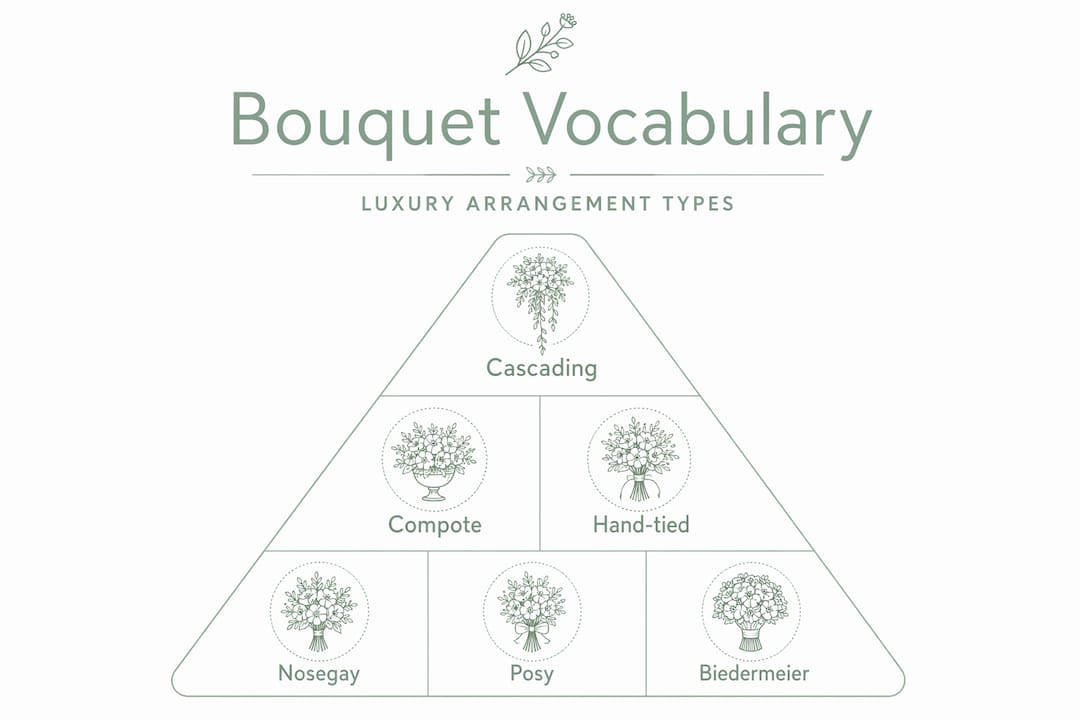
You can explore luxury bouquet types in more detail if you are building a design vocabulary around gifting and events.
Mechanics and vessels in luxury design
This is where luxury bouquet terminology gets genuinely technical, and where most newcomers to premium floristry trip up. The mechanics of an arrangement refer to the hidden structural system that holds everything in place. The vessel refers to the container that houses it. Both decisions shape every other design choice.
Here is how the two dominant mechanical approaches compare in luxury contexts:
| Approach | Description | Best suited for |
|---|---|---|
| Floral foam | Pre-soaked absorbent block; allows precise stem placement | High-volume events, complex asymmetrical designs |
| Foam-free | Chicken wire, flower frogs, or hand-tied techniques | Sustainability-focused work, organic and garden styles |
| Hybrid | Foam used selectively within a foam-free structure | Large installations where partial support is needed |
The foam versus foam-free debate has become significant in premium floristry over the last decade. Many luxury studios have moved to foam-free mechanics partly for environmental reasons, but also because the aesthetic outcome often feels more natural and less static. Foam-free designs tend to have greater movement because stems can shift slightly within the structure.
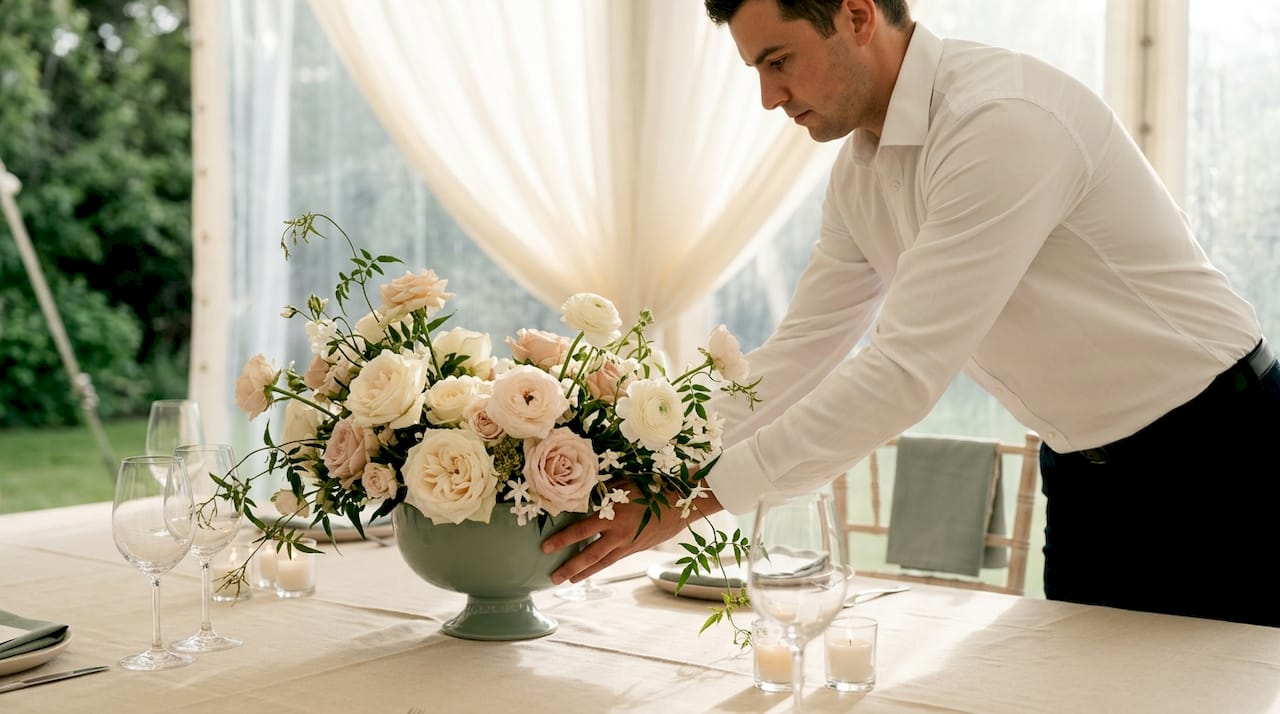
Vessel choice affects mechanics in ways that go beyond style. A compote is one of the most useful vessels in high-end event design. It is a footed bowl, typically between 20 and 40 centimetres tall, that sits low enough on a table to allow guests to see and speak across it. That height consideration is genuinely practical in event planning and is one reason compotes dominate luxury wedding reception briefs. They support both foam and foam-free mechanics and transfer well between venues.
Installations require their own category of understanding. Large-scale floral constructions like arches, flower walls, and suspended ceiling pieces are classified as installations because they demand structural engineering alongside floral artistry. The cost is driven primarily by labour and engineering logistics, not flower selection alone. A modest flower wall at a premium venue may involve scaffolding permits, attachment engineering, and a full day of installation by multiple florists. If you are pricing these for the first time, separate them from your standard floristry rates immediately.
Pro Tip: Always specify the vessel in your proposal before quoting. Swapping a compote for a cylinder vase mid-project changes the mechanics, the stem count, and the design outcome. Vessel decisions are not interchangeable.
For an in-depth look at floral craftsmanship techniques that bridge mechanics and aesthetics, Blumeflowers covers the subject with practical detail.
Luxury wedding floristry vocabulary
Wedding floristry has developed its own internal language, and understanding it is non-negotiable for anyone working in or communicating about premium events. Premium event floral vocabulary maps to specific positions within the event structure, and using the wrong term in a proposal signals inexperience.
The key personal flowers in a luxury wedding brief are:
- Bridal bouquet: The main bouquet carried by the bride. Style (cascade, posy, garden-style), colour palette, and focal flower are all specified here.
- Bridesmaid bouquets: Scaled-down versions of the bridal style, or deliberately contrasting designs used for visual interest.
- Boutonniere: A small floral piece worn on the lapel of suits, typically matching or complementing the bridal palette. Often one focal flower with minimal foliage.
- Corsage: A small arrangement worn on the wrist or pinned to clothing. Common for mothers of the wedding party and special guests.
Ceremony flowers are distinct from reception flowers, and clients often need this explained clearly. Ceremony flowers dress the architecture of the space where vows take place. These include floral arches, aisle markers (arrangements placed at the end of each row), altar arrangements, and pew decorations. Reception flowers dress the dining and social spaces afterwards.
Reception flowers carry their own precise language. Centrepieces are the arrangements placed at the centre of guest tables. These may be low (compote-height) or high (using tall structural vessels or plinths). Tablescapes refer to the complete surface design of a table, incorporating flowers, foliage, candles, and other decorative elements. A tablescape brief is broader and more expensive than a centrepiece brief because it considers the full visual experience of the table, not just the floral element.
Floristry for funerals also uses specific language, though it overlaps less with the luxury wedding lexicon. Tribute designs include coffin sprays, wreath forms, and sheaf arrangements, each with defined construction styles and protocols.
Design language and aesthetic descriptors
This is the section where floral industry jargon meets genuine creativity. Premium floral terms used to describe mood, texture, and aesthetic are the vocabulary that separates a design brief from a shopping list. Luxury is defined by intentionality and emotional resonance, not by excess, which means the language you use to describe a design must carry weight.
Here are the most useful descriptors in current high-end floral vocabulary:
- Lush: Dense, generous use of blooms and foliage with no visible structure. Signals opulence and abundance without ostentation.
- Textured: Multiple bloom types, foliage varieties, and potentially dried or seed-head elements used together to create tactile interest. The opposite of flat or uniform.
- Wild or organic: Naturalistic arrangements that reference meadow or hedgerow aesthetics. Stems at different heights, loose foliage, and a deliberately uncontrived appearance.
- Monochromatic: All flowers and foliage within the same colour family. Creates a sophisticated, considered effect and tests a florist’s skill with tonal variation.
- Ombré: A graduated colour shift from one tone to another across the arrangement. Technically demanding and visually striking when executed well.
- Movement: Refers to the visual sense that the arrangement flows or extends dynamically. Achieved with trailing foliage, wispy blooms, and deliberate stem angles.
“True luxury in floristry is refinement, personalisation, and thoughtful execution. It is achieved through mastery of textures, scale, and subtle colour layering.” Seema Shah, floral designer
These terms do more than describe. They set expectations, manage budgets, and shape the client’s emotional experience before a single stem is cut. When a client says they want something “wild but still luxurious,” that is a creative brief that requires unpacking. Asking whether they mean structured movement or a true organic garden style can be the difference between a design they love and one they cannot quite explain their disappointment with.
For further reading on how aesthetic language shapes current high-end trends, Blumeflowers covers luxury floral design trends with practical context for professionals and enthusiasts.
My perspective: why vocabulary is your most underused design tool
I have worked around luxury floristry long enough to know that the florists who grow fastest are not necessarily the ones with the most technical skill. They are the ones who can talk about what they do with precision and confidence. And that starts with vocabulary.
In my experience, the most common breakdown in luxury briefs happens not at the design stage but at the communication stage. A client asks for something “natural,” the florist interprets that as garden-style, and the client was actually picturing a monofloral design with a single sculptural tropical stem. Two completely different interpretations of the same word. Knowing the right terms, and teaching clients to use them, closes that gap entirely.
What I find most underappreciated in upscale flower vocabulary is the mechanical side. Florists who can explain the difference between foam-free and hybrid mechanics, or who can articulate why a compote works better than a cylinder for a round table, immediately signal a higher level of expertise to clients. It builds trust in a way that portfolio images alone cannot.
The insight that has stayed with me most comes from the work of designers like Seema Shah: that luxury is about intentionality, not quantity. The vocabulary reflects this. Every term, from “lush” to “ombré” to “installation,” carries with it a set of expectations about effort, cost, and craft. Mastering that language means you are not just doing the work. You are honouring it.
— Steve
Experience luxury floristry through Blumeflowers
If this guide has sharpened your understanding of what goes into a genuinely luxurious floral design, the next step is to see these terms expressed in real arrangements.
At Blumeflowers, every bouquet is built around the principles covered here. The Beautifully Simple Peony Bouquet is a textbook example of monofloral luxury, using peonies as both focal bloom and design statement in a single refined composition. For something with more colour dimension, the Showstopper Pink Bouquet demonstrates exactly what a lush, textured arrangement looks and feels like. Whether you are ordering for a corporate event, a special occasion, or exploring bespoke wedding flowers, Blumeflowers brings the vocabulary to life with the craft to match.
FAQ
What are focal flowers in luxury floral design?
Focal flowers are the primary blooms in a premium arrangement, including garden roses, peonies, dahlias, and king protea. They anchor the design visually and carry the most weight in terms of scale and form.
What does garden style mean in floristry?
Garden style refers to loose, hand-gathered arrangements with varying stem heights and visible foliage, designed to look naturally picked rather than formally constructed. It is one of the most requested aesthetics in modern luxury wedding floristry.
Why are floral installations the most expensive option?
Installations are priced higher because their cost is driven by structural engineering and labour, not flower quantity alone. A flower wall or suspended arch requires specialist rigging, multiple florists, and extended setup time.
What is a compote in floral design?
A compote is a footed bowl vessel used widely in luxury event floristry. It sits at a conversation-friendly height on dining tables and supports both foam and foam-free mechanical approaches, making it highly versatile for premium events.
What is the difference between ceremony and reception flowers?
Ceremony flowers dress the space where vows take place, including arches, aisle markers, and altar arrangements. Reception flowers cover the dining and social spaces, with centrepieces, tablescapes, and decorative elements as the primary focus.