


The art of floral presentation: style and lasting impact
TL;DR:
- Luxury floral presentation is about deliberate design mechanics—such as framing, shadowing, and layering—that create lasting visual impact. Skilled arrangements utilize negative space and asymmetry to convey sophistication, longevity, and refinement, much like high-quality art and architecture. Understanding and applying these principles elevates floral gifting and interior decor into true expressions of prestige and artistry.
There is a persistent myth in luxury gifting: that the most impressive bouquet is simply the biggest one. More stems, rarer varieties, a grander price tag. But speak to any experienced florist and they will tell you something quite different. The arrangements that genuinely move people, the ones that command a room, linger in the memory long after the petals have fallen, are built on something far more considered. Floral presentation, the purposeful orchestration of structure, space, rhythm, and technique, is where true artistry lives. And once you understand it, you will never look at a bouquet the same way again.
Table of Contents
- What is floral presentation and why does it matter?
- The mechanics behind stylish arrangements
- The art lover’s view: mid-century floral presentation as prestige and collectability
- Applying floral presentation: real-world scenarios for stylish gifting and spaces
- Why ‘emptiness’ and spacing elevate true luxury: a florist’s perspective
- Experience extraordinary floral presentation with Blüme Flowers
- Frequently asked questions
Key Takeaways
| Point | Details |
|---|---|
| Presentation surpasses quantity | Expert mechanics and balance define luxury arrangements, not just more or rarer flowers. |
| Mechanics drive style | Techniques like framing, layering, and negative space create structure and sophistication. |
| Artistry adds value | Mid-century and collectable floral works owe their value as much to presentation as to materials. |
| Application is practical | Anyone can request refined presentation by focusing on spatial planning and purposeful design. |
What is floral presentation and why does it matter?
Floral presentation is not simply the act of placing flowers together in a pleasing fashion. It is a deliberate design discipline that governs how blooms relate to one another, to their container, and to the space around them. Think of it as architecture for flowers. Just as a well-designed room feels effortless yet functions with precision, a well-presented arrangement carries invisible logic beneath its beauty.
For affluent clients commissioning arrangements for weddings, corporate headquarters, or a carefully curated home interior, this distinction carries real weight. A bouquet that is technically well-presented communicates taste, intentionality, and prestige. One that is simply “full” can feel chaotic, regardless of how expensive the individual blooms are.
The connection between bouquets and atmosphere is well established among interior designers and event stylists. Flowers do not just decorate a space. They alter the emotional register of a room. A tightly packed arrangement might convey warmth and abundance. A spare, architecturally placed stem in a tall vessel can signal calm authority. Neither is universally superior. But both require mastery to execute with conviction.
“Presentation is driven by arrangement mechanics such as framing, shadowing, sequencing, zoning, layering, and lacing.” — Sharon McGukin, floral design educator
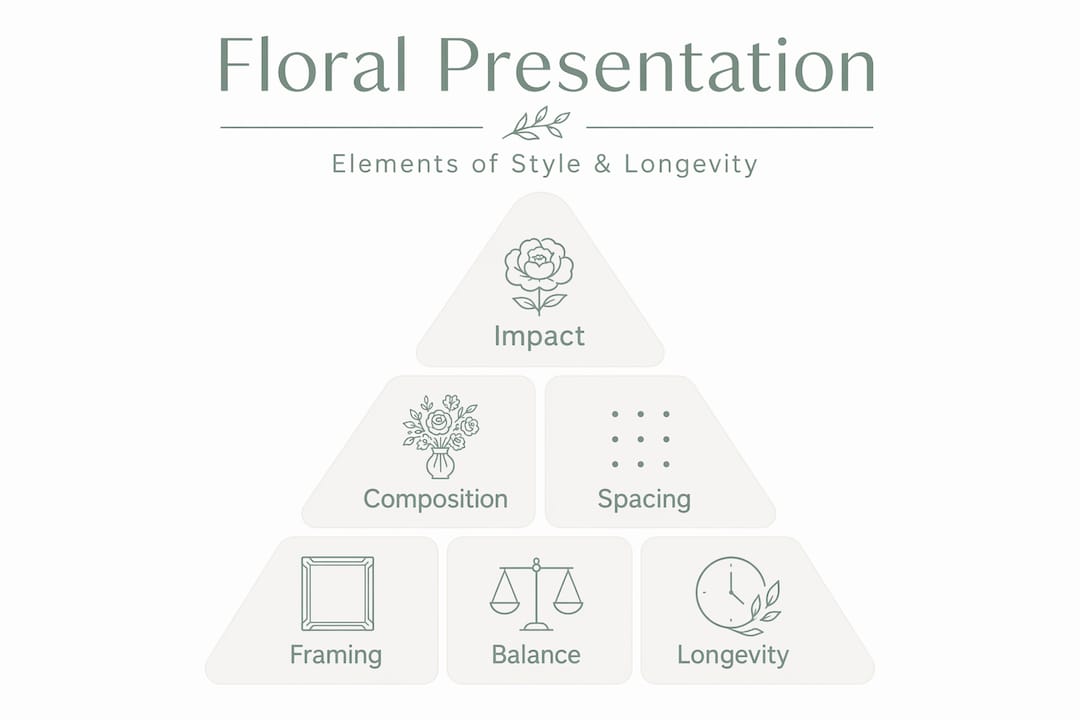
The key elements that define sophisticated floral presentation include:
- Framing: Using foliage or supporting blooms to draw focus toward the centrepiece flowers
- Shadowing: Placing darker or deeper toned blooms behind lighter ones for depth and dimension
- Sequencing: Directing the viewer’s eye through the arrangement in a deliberate order
- Zoning: Grouping varieties or colours to create distinct visual moments within one arrangement
- Layering: Building height and texture at varying levels for a three-dimensional effect
- Lacing: Weaving stems so they support one another, creating structural integrity without visible mechanics
Each of these elements serves both aesthetic and structural purposes. A bouquet built on these principles lasts longer, photographs better, and holds its form across the duration of an event.
The mechanics behind stylish arrangements
With an understanding of presentation’s importance, it is time to explore the core mechanics that make arrangements both beautiful and structurally refined. These are not abstract artistic notions. They are learnable, repeatable techniques that separate amateur floristry from genuine floral craftsmanship techniques used by the best in the field.
Here is how the main mechanics work in practice:
-
Framing creates a boundary that tells the eye where to look. Eucalyptus, bear grass, or sculptural foliage at the outer edges of an arrangement function like the frame around a painting. They contain the composition and make the centrepiece blooms feel intentional rather than incidental.
-
Shadowing introduces depth by positioning darker blooms slightly behind and below their neighbours. This prevents the flat, “face-on” look that plagues average arrangements and gives the piece a painterly quality.
-
Sequencing is rhythm made visible. A skilled florist leads the eye from one focal point to another in a way that feels natural, almost like a melody. Disrupting sequencing creates visual noise. Getting it right creates flow.
-
Zoning allows complex, multi-variety arrangements to feel cohesive. Rather than scattering different flowers randomly, zoning clusters them. The result is a composition that feels considered rather than haphazard.
-
Layering builds volume without crowding. By working at three distinct height levels, low, mid, and high, a florist creates a sense of abundance that does not compromise negative space.
-
Lacing is perhaps the most structural of the mechanics. When stems are woven together correctly within the vase or binding, they become self-supporting. This is what allows a bouquet to maintain its form through a long event or a delivery journey.
The standout arrangement secrets used by top florists also draw heavily on negative space and asymmetry. Negative space and asymmetry are core to sophisticated presentation, according to RHS guidance. Asymmetrical arrangements feel alive and natural. Perfectly symmetrical ones, by contrast, can feel stiff and corporate in the least flattering sense.
| Technique | Visual effect | Best suited to |
|---|---|---|
| Framing | Focus and containment | Statement gifting bouquets |
| Shadowing | Depth and dimension | Photography, events |
| Negative space | Calm, luxury, restraint | Corporate, interiors |
| Asymmetry | Natural, dynamic energy | Weddings, art displays |
| Layering | Volume without crowding | Large centrepieces |
| Zoning | Cohesion and clarity | Multi-variety luxury bouquets |
Pro Tip: When assessing any arrangement, look at the spaces between the flowers as much as the blooms themselves. If those spaces feel intentional, you are looking at high-calibre work. If they feel accidental, the underlying mechanics need attention.
The art lover’s view: mid-century floral presentation as prestige and collectability
Beyond live arrangements, the significance of floral presentation extends into the world of art and mid-century collectibles, revealing why expert presentation is not just about show. For those with an appreciation for design history and the decorative arts, the principles that govern a luxury bouquet are the same ones that underpin highly valuable works.
Mid-century designers understood that the constructed image of a flower, or indeed the constructed object of an everlasting floral arrangement, could carry as much cultural currency as any fine painting. Mid-century “everlasting flowers” were meticulously arranged with engineered stems and structure to allow lasting visual form. These were not casual decorative objects. They were exercises in precision, designed to hold a composition for years rather than days.
At the highest level of the art market, composition and preservation quality directly affect desirability and the market value of floral artworks. Christie’s documentation of the Dutch Golden Age master Jan van Huysum makes this point with particular clarity. Van Huysum’s floral paintings commanded extraordinary prices not merely because of the flowers depicted, but because of the extraordinary compositional intelligence in how they were arranged on the canvas. Framing, sequencing, and zoning were as central to his method as pigment.
This is the lens through which Blüme Art approaches reclaimed mid-century pieces. Each work is assessed not just for condition but for the quality of its original compositional thinking. Does it use negative space with intention? Does the eye move through the piece in a satisfying sequence? These are the questions that determine whether a piece has genuine prestige.
Key considerations when evaluating mid-century floral art or decorative arrangements:
- Structural integrity: Has the original engineered form been maintained or thoughtfully restored?
- Compositional intelligence: Does the piece use recognised mechanics such as framing and zoning?
- Preservation state: Surface condition, colour retention, and material stability all affect value
- Provenance: Documented origin and history substantially increase desirability
- Contextual rarity: Pieces that reflect a specific period’s aesthetic vocabulary command premium interest
| Factor | Impact on value | Relevance to presentation |
|---|---|---|
| Composition quality | High | Direct |
| Preservation state | High | Direct |
| Material rarity | Medium | Indirect |
| Provenance | High | Contextual |
| Period authenticity | Medium to high | Direct |
For those interested in luxury bouquet types and how they relate to a wider aesthetic programme in the home, the parallels between fine floral art and live arrangement are more than stylistic. They point toward a shared understanding of beauty as something engineered, not merely gathered.
Applying floral presentation: real-world scenarios for stylish gifting and spaces
With both the art and science of presentation in mind, here is how you can experience and apply these principles in real life. Whether you are commissioning an impressive arrangement for a significant personal occasion or specifying corporate floral displays for a client-facing environment, the same fundamentals apply.
Here is a practical checklist for commissioning a high-calibre arrangement:
-
Specify your display environment. A dining table centrepiece behaves differently from a reception desk arrangement. Give your florist the dimensions of the space and the dominant colour palette.
-
Ask about structural technique. Specifically request that the florist uses lacing and layering to ensure the piece holds its form. This matters especially for delivery arrangements.
-
Request negative space. This is the clearest signal you can give that you want a luxury result rather than a packed bunch.
-
Discuss asymmetry. Even a slight asymmetrical lean gives an arrangement vitality. Ask for it explicitly if you want that natural, artful quality.
-
Consider seasonal blooms. Seasonal floral style not only looks better, it is structurally sounder. In-season flowers are at their structural peak, which means they hold form longer and respond better to the mechanics your florist applies.
-
Specify longevity requirements. If the arrangement needs to perform across a three-day corporate event, that requires a different structural approach than a one-evening dinner party centrepiece.
-
Ask for a composition rationale. Any florist worth commissioning should be able to explain why each element is placed where it is. If they cannot, their approach is intuitive rather than intentional.
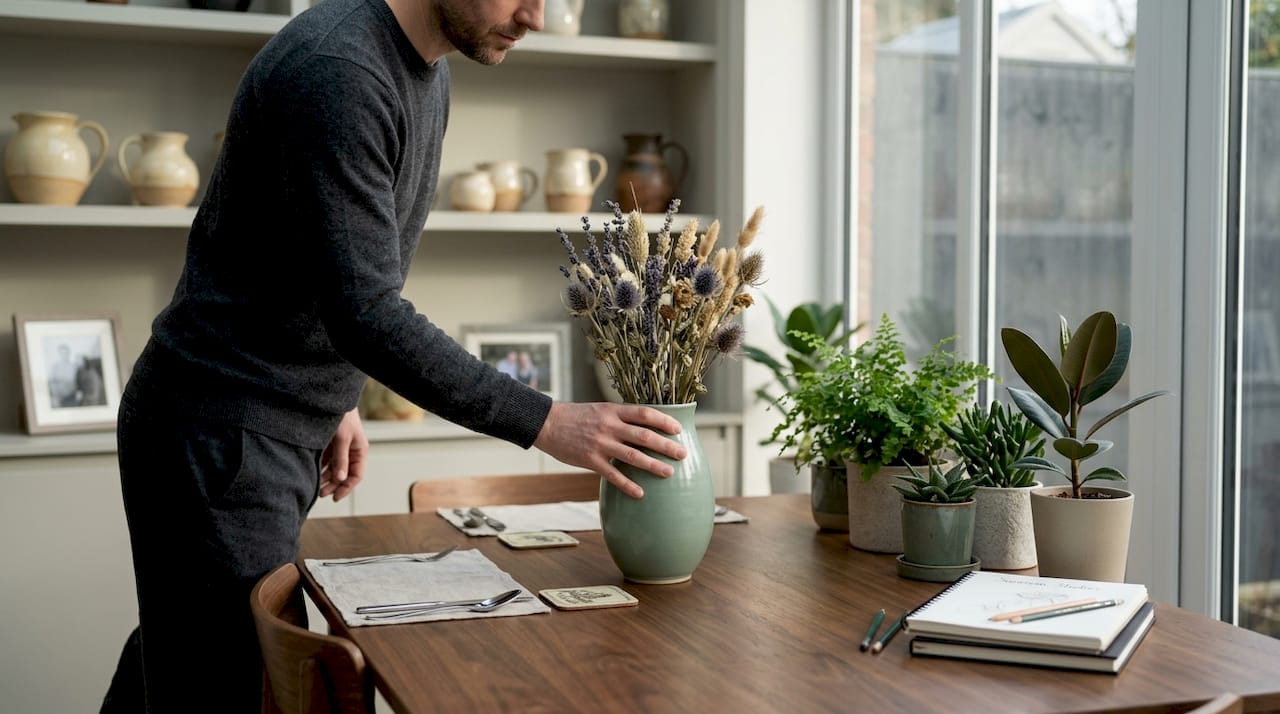
Applying these principles at home is equally satisfying. For everlasting or dried arrangements, which are increasingly popular in design-conscious Birmingham and Solihull interiors, the same mechanics apply with the advantage of permanence.
Pro Tip: Before placing any arrangement, consider negative space and clear visual clutter from the immediate area around the vase. An arrangement that appears cluttered in one context can transform into something architectural when given space to breathe.
Why ‘emptiness’ and spacing elevate true luxury: a florist’s perspective
Practical applications show us the “how”, but a fresh perspective reveals the “why.” And the truth, the one that surprises most new clients, is that restraint is the most expensive thing you can buy in floristry.
When a client first encounters a premium arrangement built on controlled spacing, there is often a moment of hesitation. “Is that it?” they wonder. Then they live with it for a day. The eye keeps returning to it. It does not fatigue. It does not compete. It settles. That quality, the ability of an arrangement to remain compelling without demanding attention, is the product of genuine mastery, and it is very hard to manufacture.
Luxury presentation comes as much from controlled emptiness and spacing as from the density or monetary value of the blooms themselves. This is a principle borrowed directly from fine art, architecture, and high-end interior design. White space on a gallery wall is not wasted space. It is the mechanism by which the art breathes.
The high-end clients we work with in Birmingham and Solihull are increasingly drawn to this sensibility. They have moved past the impulse to fill. They want floral mood setting that is specific, intentional, and quietly confident. They want an arrangement that says something without shouting it.
There is also a practical dimension to this philosophy. Overcrowded arrangements trap moisture, reduce air circulation between stems, and accelerate decay. Spacing is not just aesthetically superior. It is physiologically better for the flowers. A well-spaced arrangement lasts demonstrably longer than a densely packed one, which makes it better value, not worse.
The parallel with mid-century floral art is striking here too. The pieces that retain the most value are rarely the most elaborate. They are the ones that show the most control. Control of space, of colour relationship, of compositional hierarchy. That is where true prestige resides.
Experience extraordinary floral presentation with Blüme Flowers
If this article has shifted how you think about what makes a bouquet truly impressive, the next step is experiencing that difference first-hand. At Blüme by Urban Design Flowers, every arrangement is built on the same principles explored here: intentional structure, purposeful negative space, and the kind of compositional rigour that separates a luxury piece from a standard delivery.
Whether you are looking for a statement birthday arrangement, a bespoke sympathy tribute, or a refined ongoing corporate floral programme for your Birmingham or Solihull premises, we bring the same attention to mechanics and artistry to every brief. We offer same-day and next-day delivery across the region, and our team is available to consult on bespoke arrangements where presentation is non-negotiable. Browse our full collection at blumeflowers.co.uk and discover what thoughtful floral presentation truly feels like.
Frequently asked questions
What are the most important mechanics in luxury floral presentation?
The key mechanics include framing, shadowing, sequencing, zoning, layering, and lacing, each contributing both to the visual appeal and the structural integrity of the arrangement.
Why is negative space important in floral arrangements?
Negative space adds balance and sophistication, allowing individual blooms to stand out and creating the kind of restrained luxury that distinguishes premium arrangements from generic ones.
How does floral presentation affect the value of art or collectible pieces?
Composition and preservation quality have a direct bearing on the desirability and market value of floral artworks, with compositional intelligence often outweighing rarity of subject matter.
Can mechanical techniques enhance both fresh and artificial arrangements?
Yes. Mid-century everlasting arrangements used engineered stems and deliberate structural mechanics to maintain their visual form over years, proving that these principles apply equally to preserved and fresh designs.
What should I ask my florist to ensure high-calibre presentation?
Request explicit use of negative space and asymmetry, along with purposeful stem placement and a clear rationale for the compositional choices made in your arrangement.