


The role of craftsmanship in bouquets: a complete guide
Why craftsmanship defines every great bouquet
Skilled craftsmanship is what separates a bouquet that lasts a fortnight and stops a room from one that wilts by Thursday. The role of craftsmanship in bouquets goes far beyond arranging stems attractively. It is a deliberate, trained process of applying formal design principles, conditioning techniques, and structural mechanics to create something with genuine longevity and visual integrity.
In professional floristry, craftsmanship covers a specific set of practices:
- Conditioning: hydrating and preparing stems for hours before any design work begins
- Stem cutting: angled cuts at precise lengths to suit each bloom’s position in the composition
- Armature building: constructing the structural framework, whether chicken wire, pin frogs, or wire, that holds the design in place
- Grooming: removing foliage below the waterline, de-thorning, and stripping damaged petals
- Vessel selection: choosing a container that complements the flowers rather than competing with them
The difference between a handcrafted bouquet and a mass-produced one is not merely aesthetic. City & Guilds floristry qualifications codify these skills into formal training standards at Level 2 and Level 3, covering design, plant care, and safe handling. The British Florist Association reinforces this through its Institute of Professional Florists, which requires members to demonstrate ongoing professional development. Together, these bodies define what craftsmanship actually means in a professional context, not as a vague quality claim, but as a measurable set of skills.
How UK floristry craftsmanship evolved over the centuries
British floristry has a longer and more structured history than most people realise, and understanding that history explains why certain techniques still dominate today.
Key milestones in the development of UK floristry craftsmanship:
- Medieval and Tudor periods: flowers were used primarily for symbolism and scent rather than visual composition; posies and tussie-mussies carried medicinal herbs alongside blooms
- Victorian era: the language of flowers, or floriography, gave bouquets coded meaning; tight, rounded nosegays became fashionable, demanding precise wiring and careful stem management
- Early 20th century: the rise of professional florist shops in British high streets brought commercial demand, pushing florists to develop faster conditioning and assembly methods
- Post-war period: the establishment of formal training routes, including early City & Guilds floristry programmes, began standardising craft knowledge across the trade
- 1980s and 1990s: European influences, particularly from Dutch and Belgian schools, introduced more sculptural, asymmetric designs that challenged the traditional round bouquet
- 2000s onwards: growing environmental awareness prompted a shift away from floral foam towards wire armatures and natural mechanics, reshaping both technique and ethics in the craft
The guild tradition in British craft trades directly influenced floristry’s professional culture. Florists who trained through formal apprenticeships carried a sense of responsibility to the craft that persists in organisations like the British Florist Association today. The challenge throughout this history was consistent: how to preserve the integrity of living material while meeting commercial timescales. Solutions evolved from simple cold-water conditioning to the sophisticated pre-treatment protocols used in luxury studios now.
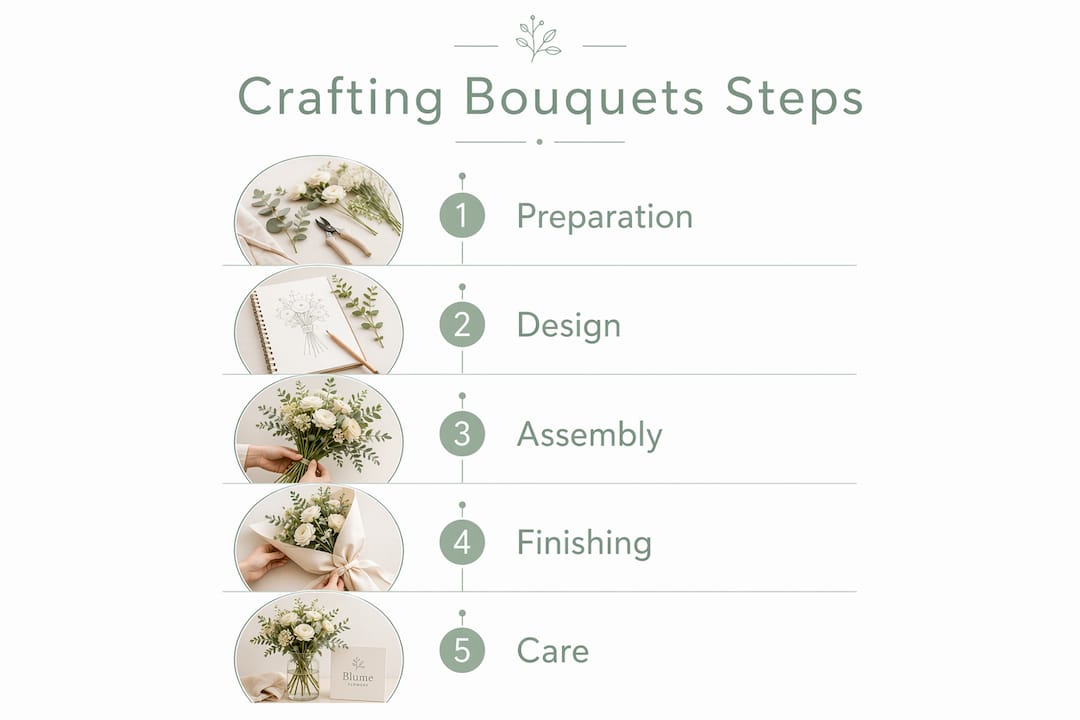
What traditional and modern techniques actually look like in practice
The craft of bouquet making draws on a surprisingly wide toolkit, and the gap between traditional and contemporary methods is narrower than you might expect. Most skilled florists use both, choosing the technique that best serves the specific design.
Traditional methods:
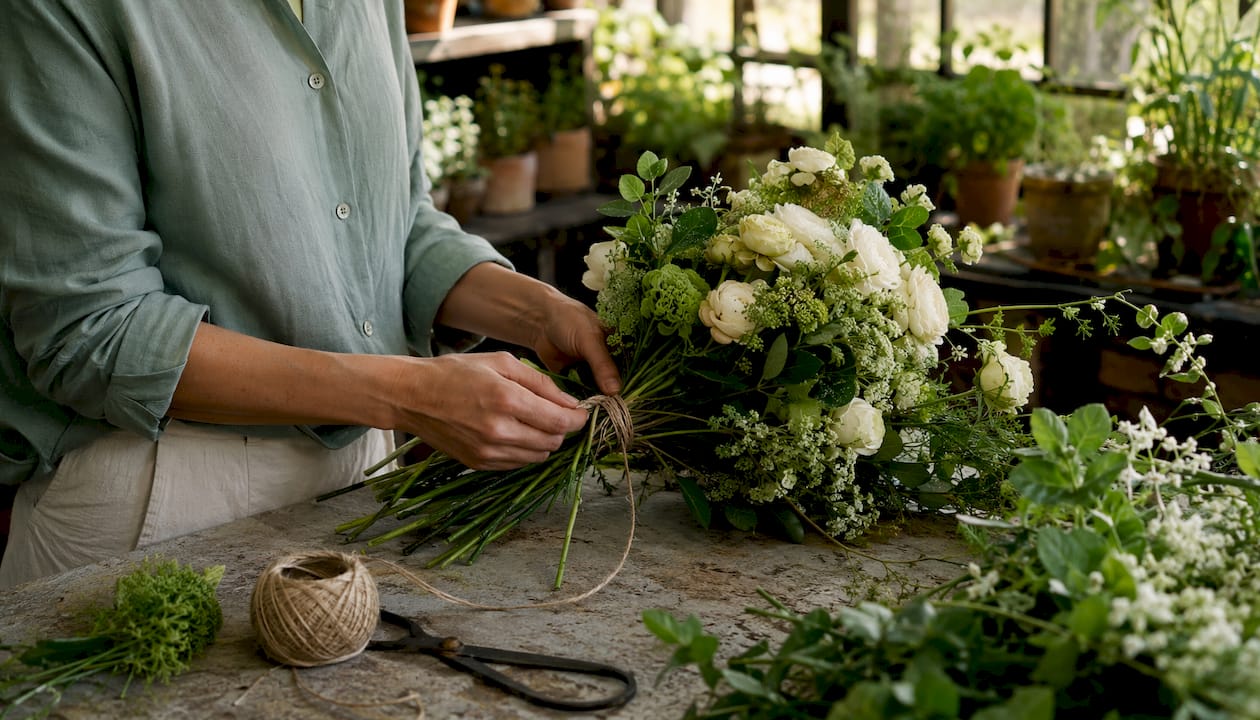
- Hand tying: building a spiral-stemmed bouquet by rotating each stem at a consistent angle, creating a self-supporting structure that stands in water without mechanics
- Wiring and taping: individually wiring delicate blooms or foliage to give them directional control, then taping the wire to mimic a natural stem; essential for corsages, boutonnieres, and bridal work
- Conditioning: placing freshly cut stems in clean water for an extended period before arranging, allowing blooms to fully hydrate and open at the right pace
Modern innovations:
- Foam-free mechanics: wire armatures and pin frogs replace floral foam, reducing plastic waste and allowing flowers to move naturally rather than being locked into a rigid grid
- Sustainable materials: moss, willow, and natural binding twine replace synthetic wrapping and tape in many contemporary designs
- Structural armatures: chicken wire formed into a dome inside a vessel gives stems directional support while preserving the organic quality of the arrangement
Statistic callout: A hand-tied luxury arrangement involves a significantly longer skilled design process per piece, compared to the very rapid assembly of a mass-produced grocery bouquet in a regional packing facility. That gap in time investment is the clearest single measure of what craftsmanship costs and what it delivers.
The most visible difference between the two approaches is movement. Foam-locked arrangements look static; wire-supported ones allow stems to follow their natural arc. For floristry enthusiasts working on luxury floral techniques, understanding which mechanic to use for which design is one of the most transferable skills you can develop.
Pro Tip: When building a hand-tied bouquet, keep your binding point fixed and rotate the bouquet rather than the stems. This maintains the spiral angle consistently and prevents the design from collapsing as you add material.
How formal training and qualifications shape craftsmanship quality
Formal training is where craft knowledge becomes transferable and consistent. Without it, even a talented florist risks developing idiosyncratic habits that work in one context and fail in another.
The City & Guilds framework offers the most widely recognised route in the UK:
- Level 2 Technical Certificate in Floristry: covers fundamental skills including conditioning, hand-tied bouquets, wired designs, and the principles and elements of design; introduces health and safety in a commercial context
- Level 3 Advanced Technical Diploma: extends into event floristry and advanced design, business management, and industry trends; requires students to interpret a client brief and produce competition-standard work
- Level 4 Higher Diploma (ICSF): the qualification required for Licentiate membership of the Institute of Professional Florists, signalling the highest level of formal attainment
The British Florist Association’s Institute of Professional Florists requires members to accumulate 20 continuing professional development points per membership year, ensuring that qualification is not a one-time event but an ongoing commitment. This matters to customers because it means a florist displaying IoF membership has actively maintained their skills, not simply passed an exam years ago.
Beyond technical ability, formal training instils design literacy. Students learn to apply principles such as balance, rhythm, focal point, and negative space to real briefs. They also learn to sketch designs before building them, a discipline that sharpens visualisation and prevents costly mid-construction changes. The British Florist Association’s training guidance is explicit that practical experience alone, without formal accreditation, leaves gaps in both technical knowledge and business competence.
Pro Tip: If you are evaluating a florist for a significant commission, ask whether they hold a City & Guilds qualification or IoF membership. These are publicly verifiable credentials, not marketing claims.
Craftsmanship as an art form: tradition, sustainability, and natural form
The best floristry is not just technically correct. It has a point of view. Craftsmanship at its highest level is the place where skill and artistic intention meet, and where the florist’s choices about form, movement, and material become a coherent statement.
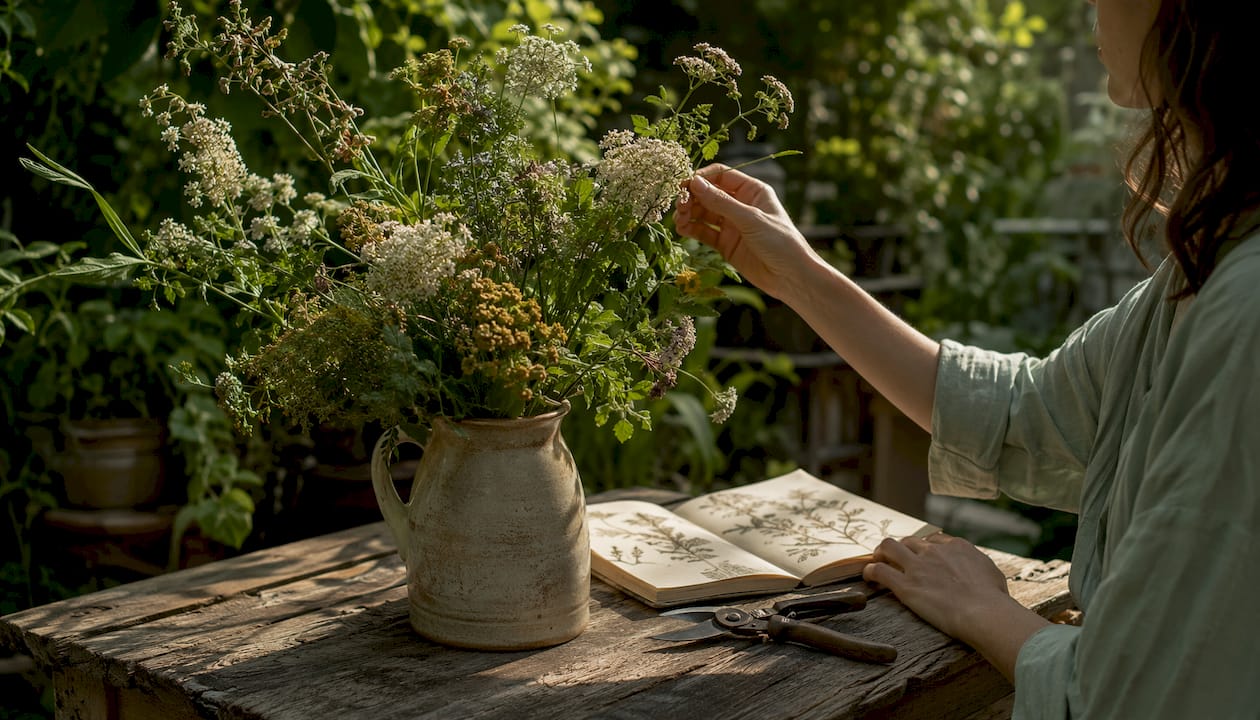
Gregor Lersch, one of the most influential floral designers of the modern era, has consistently argued that the future of floristry lies in understanding and respecting the natural character of plant material rather than forcing it into predetermined shapes. His work bridges the European tradition of structured floral design with a philosophy that treats each stem as a living element with its own logic.
This shift in thinking has practical consequences. Artisan florists who work with the natural form of their material, rather than against it, tend to favour wire armatures over foam precisely because sustainable floral mechanics allow stems to follow their own arc. The result is a bouquet that looks alive rather than constructed. Negative space, the deliberate absence of material in parts of the design, becomes a compositional tool rather than an oversight.
Sustainability and artistry are not in tension here. Rejecting floral foam reduces microplastic contamination in waterways, but it also produces better-looking work. The ecological and aesthetic arguments point in the same direction. For florists exploring modern floral styling, this convergence is one of the most exciting developments in contemporary practice.
The botanical approach to beauty and ritual in adjacent creative fields reflects the same underlying principle: that working with natural materials at their best, rather than processing them into submission, produces the most resonant results.
Insights from BLÜME: luxury floral craftsmanship in the contemporary UK market
BLÜME by Urban Design Flowers, based in Birmingham, applies the principles of skilled craftsmanship to every bouquet it produces, from a birthday hand-tied to a corporate installation. The brand’s approach illustrates what luxury floral craftsmanship looks like when it moves from theory into daily practice.
The key elements of BLÜME’s craftsmanship process:
- Extended conditioning: stems are hydrated and prepared well before any design work begins, ensuring blooms open at the right pace and hold their form throughout the bouquet’s life
- Bespoke vessel selection: containers are chosen to complement the specific flowers and occasion rather than defaulting to a standard vase; the vessel is treated as part of the design, not packaging
- Meticulous grooming: foliage below the waterline is removed, damaged petals are stripped, and each stem is cut to the precise length its position in the spiral demands
- Design principle application: balance, focal point, rhythm, and negative space are applied to every composition, not just competition pieces
- Sustainable mechanics: wire and natural binding materials replace foam wherever possible, reflecting both environmental responsibility and a preference for natural movement in the finished design
The pricing of a handcrafted luxury bouquet reflects this invisible labour. A luxury hand-tied arrangement carries substantial non-product costs: skilled design time, conditioning hours, vessel investment, and studio overhead. These are not margins; they are the cost of doing the work properly. A mass-produced bouquet eliminates almost all of them.
For customers, this distinction shapes the entire experience. A bouquet from BLÜME arrives looking finished and holds its form for days longer than a supermarket equivalent, because the work that produces that result happened long before the flowers were wrapped. Craftsmanship, in this context, is not a premium add-on. It is the product itself.
If you want to experience what skilled bouquet making produces, the Beautifully Simple Peony Bouquet from Blumeflowers is a direct expression of these principles: conditioned blooms, considered form, and a design that holds its quality from delivery to the final day.
Key takeaways
Craftsmanship in floristry is defined by the integrity of the entire process, from conditioning and structural mechanics to design principles and sustainable materials, upheld through formal qualifications and continual professional learning.
| Point | Details |
|---|---|
| Craftsmanship is a process, not a style | It covers conditioning, grooming, armature building, and design principles applied before a single stem is placed. |
| Formal qualifications set the standard | City & Guilds qualifications at various levels define measurable craftsmanship benchmarks in UK floristry. |
| Labour time is the real differentiator | A handcrafted luxury bouquet requires significantly more skilled design time compared to the very rapid assembly of a mass-produced grocery bouquet; this difference in labour investment defines what craftsmanship delivers. |
| Sustainable mechanics improve both ethics and aesthetics | Wire armatures and pin frogs replace floral foam, reducing environmental impact while allowing flowers natural movement. |
| Ongoing development sustains quality | British Florist Association IoF members must regularly maintain evidence of ongoing professional development, ensuring skills remain current and verifiable. |